The answer to the prison crisis in CA is *not* more prisons

Prisons, like guns, have the unique identity of constantly being seen as the answer to the problems they individually create. Very few people, besides drug addicts & delusional Libertarians, would argue that the answer to cocaine addiction is more cocaine. But when it comes to public safety, more guns and more prisons are the politically popular response to dealing with the issues that spring up from the proliferation of guns and prisons in society in the first place.

This blogger’s friend recently wrote a nifty piece about how local municipalities in the Bay Area clamor for more jails to fix existing problems. The past 40 years serve as a testament to the fact that CA cannot incarcerate it’s way out of the contemporary prison crisis. Are there any business models that receive annual budget increases despite 60-70% failure rates? *cough* CDCR *cough*

Modern incarceration is very expensive, but invests very little in inmates while they are being housed. Programs are few and far in between. The recidivism rates are as shocking as they are simple. Solving the numerous problems stemming from CA’s prison crisis is not straight forward. On the legislative spectrum updated penal sentencing laws are desperately needed (locking up inmates and throwing away the key is the definition of a zero-sum game). Barriers to re-entry like employment and housing discrimination also need to be addressed in proper legislative channels. But there’s only so much the law can do. Changing social attitudes towards inmates is a difficult beast to tame. Caging the primal instinct for retribution when one is harmed is even harder to corral. Prisons need to be re-envisioned to help inmates get better, not worse. It’s cowardly to sit back and watch a social problem swallow communities whole and do nothing but feel bad for them. The last thing you want for someone growing up is to not having anything in life to look forward to, because those are the people who are likely to do anything just to get something. The system is broken, but not so much so that it’s beyond repair. This blogger firmly believes that empathy is the crucial factor that is acting as a roadblock to CA’s prison problems.
The missing link between colleges & prisons in CA

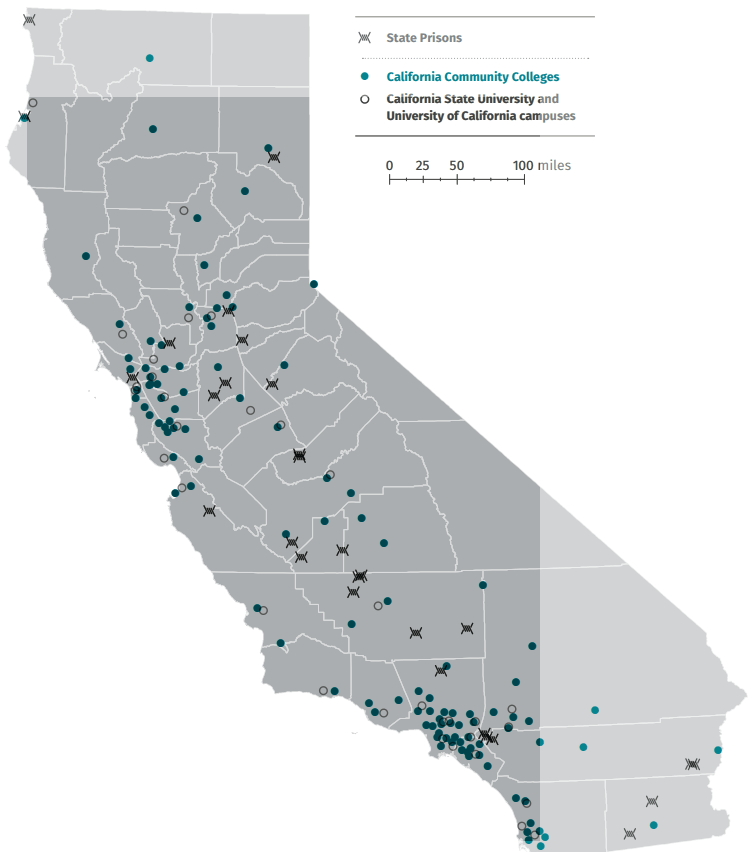
The majority of people incarcerated in CA on any given day — around 130,000 as of June ’17 — are in state prisons. 96% of these individuals will eventually return to the community, and over 50,000 are within 2 years of release. In CA, 21 of the 35 prisons are located within 20 miles of a community college.

CAA.PNG

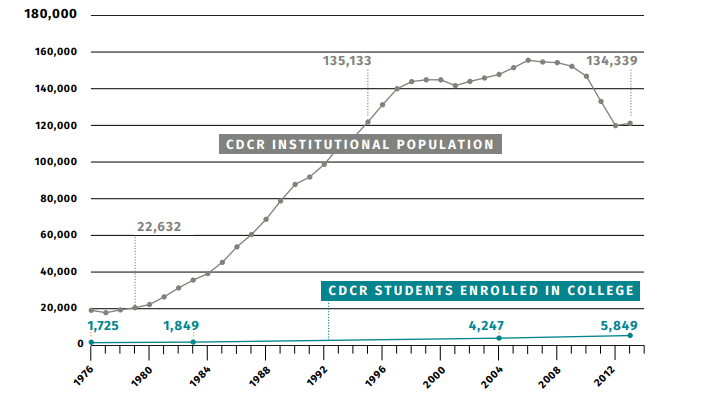
In 1971-72, all but one CDCR facility had at least one college course offered in its prison. Between the 1970’s and today the prison population grew by more than 700%, but access to college inside prisons didn’t keep pace. In 1976, approximately 21,000 men and women were incarcerated in CA prisons. That same year, 1,725 students (8.6% of state prison inmates) were enrolled in college. By 1983, the prison population had nearly doubled, but the number of students enrolled in college had grown only to 1,849 (4.7% of the CDCR population). For the next several decades, the CA prison population continued to grow rapidly, reaching a peak of over 172,000 in 2006. By 2013, only 4.4% (5,849 of 134,339) of the state prison population was enrolled in college.

CA.PNG

In-person courses in CA prisons dropped dramatically in the early 1990’s. This drop can be attributed to many factors, including reductions in prison education budgets and a loss of funding streams that were previously available to community colleges. Additionally, the 1994 Violent Crime Control and Law Enforcement Act prohibited students incarcerated in state prison from receiving Pell Grants. (Reminder that Bill Clinton had really, really bad ideas about criminal justice). These factors combined to decimate the number of college programs offered inside CA prison walls. Only one in-person program was restarted – at San Quentin State Prison – and it currently exists as an independent nonprofit organization, partnering with a private college and relying on foundation grants, donations, and volunteer instructors.

Today, CDCR has an office of Correctional Education that oversees the education programs offered across CA’s prisons. Every CDCR facility has an education department, but the majority of their education resources go to ABE (Adult Basic Education), GED or high school equivalency classes, and CTE (Career Technical Education). This is largely due to the low achievement of incarcerated folks. Men incarcerated in CA prisons have an average reading score of 8.3 (indicating an 8th grade reading level), language score of 6.2, and a math score of 6.8. Women have average scores of 9.1, 7.2, and 6.8, respectively.

CA should improve and expand high-quality college offerings in prison, given the many benefits that accrue from a college education. For individuals returning home from prison, a college education can offer increased job prospects and greatly improves their chances of successfully reintegrating into their communities. Making life easier, not harder, for recently released inmates needs to be implemented into the prison equation.

This blogger understands that dismantling the roots of recidivism is not as simple as increasing the amount of college courses available in prison. But meta-analyses have found that participation of any kind in educational programs during incarceration reduces an individual’s likelihood of recidivating by 43%.  These findings are supplemented by an evaluation at San Quentin that found the three-year recidivism rate for both new offenders and parole violations among Prison University Project graduates was 17%. In the 11 years since the program began collecting data – during which time it served over 1,000 students – no Prison University Project graduate has returned to prison for committing a violent crime. The bottom line is that a college education is the ticket to autonomy in life, for UC students as much as incarcerated students.

Education is freedom

This article is an example of the type of prison reform we need more of to improve our massive investment in prisons.

The difference between a college degree and high school degree is $1 million in income over an individual’s life. If one has $1 million more in their pockets throughout life, perhaps they wouldn’t turn to crime to fulfill their needs.

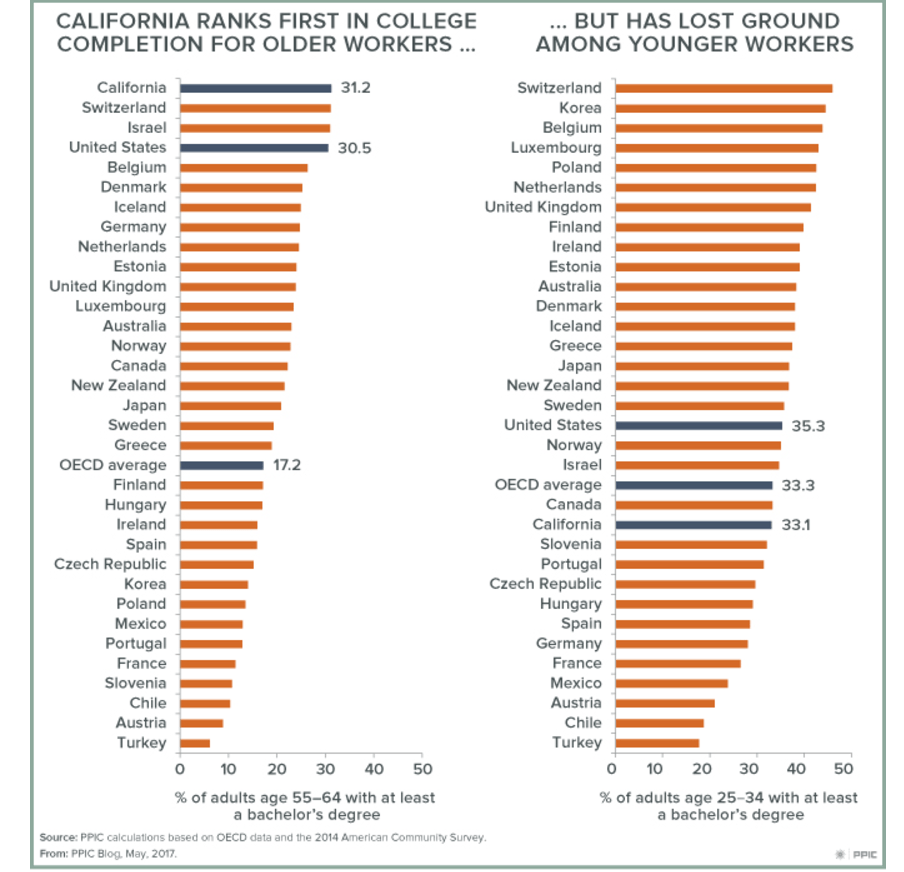
CA has seen stagnant educational attainment over the past 40 years. Compare this graphic with CA’s bulging prison rates and it becomes apparent by investing less in education we’ve doomed ourselves into investing more in prisons. Autonomy rebuffs criminality and education is a surefire way to produce autonomy in life.

Stagnant Generational Educational Progress in CA.PNG

Staggering Recidivism Rates

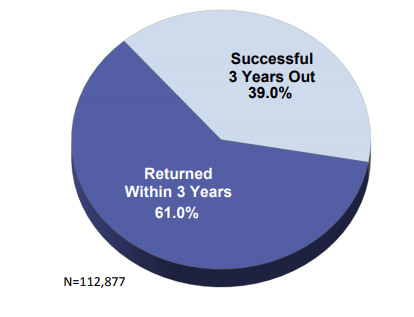
CDCR releases annual Recidivism Rate Reports that beg a fundamental question: What exactly are our prisons rehabilitating? The last available report finds that the tendency for CA inmates to return to prison within three years currently sits at 61%.

recidivism

Recidivism rates have been decreasing since the early 2000’s. So instead of 7 out of 10 inmates returning to prison walls within three years, the contemporary rate is only 6 out of 10 in CA.

Recidivsmmm

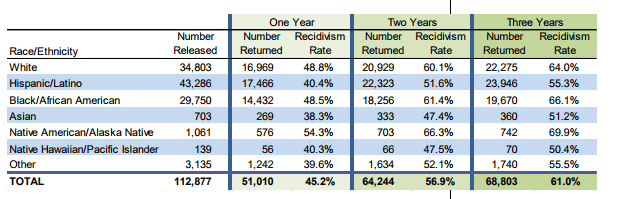
Ethnic breakdowns of CA recidivism rates illuminates how deeply connected the back end of the prison system is connected to the front end. Across all groups, the likelihood of returning to prison increases over time from Year 1 to Year 3.

re

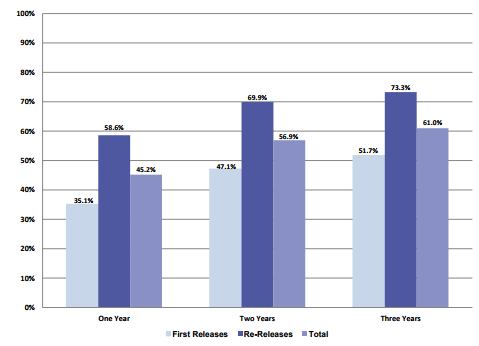
Re-releasers are more likely to recidivate than first releasers. This is where the metaphor of the revolving door of prison admissions comes into play. Once the criminal justice system has its tentacles draped over an individual they are likely to feel its wrath for the rest of their lives.

recc

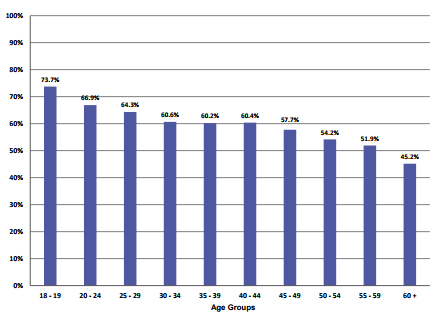
Young people are more likely to recidivate. This is line with common literature that finds as individuals get older they tend to desist out of criminality. This trend tracks hormone levels like that of testosterone, or the body’s declining ability to absorb dopamine over time. Brains under the age of 25 are still forming and thus are more vulnerable to peer pressure or impulsivity. This trend is especially tragic as one reflects on the simple fact that the young years of one’s life set the foundation for a successful (or fractured) future.

recccc

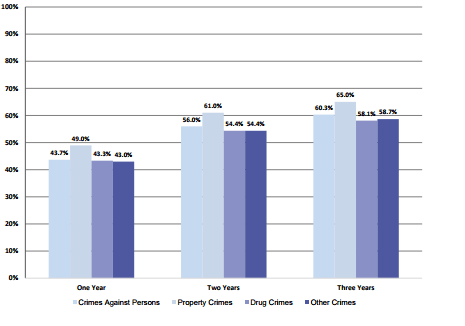
Property crimes & crimes against persons are the most common type of offenses that recidivists commit. This is line with what we know about the proliferation of these charges fueling prison admissions in the first place. It’s beyond time to shatter the false narrative that the majority of CA inmates are incarcerated for non-violent offenses like smoking pot. It’s uncomfortable to reckon with the reality that violent crimes are prevalent in our neighborhoods, but the longer we bury this truth the further we get from approaching meaningful reform.

ree

Here’s a radical thought: Perhaps if there weren’t 44,000 legal discriminatory barriers to re-entry recidivism rates wouldn’t be so high? Common sense would indicate we should be making it easier for our citizens to take advantage of their second chances in life, not erecting roadblocks at every turn that funnel them back into prisons. Prisons are monster factories that make bad people worse. It doesn’t take much thought to realize our prisons are offering society a very, very poor return on its massive investment. Tough on crime doesn’t have to mean abandoning smart on crime initiatives.

Million Dollar Hoods

UCLA researchers have launched a mapping database that shows the disparate impact of the Los Angeles county jail system – the largest in the United States. Million Dollar hoods maps how much money the LA County Sheriff’s Department and LAPD spend per neighborhood to incarcerate residents in county and city jails. The project has provided unprecedented transparency and public access to jail data in LA and identifies patterns of incarceration throughout the country. The mapping tool also allows users to examine data by race, gender, type of crime, and leading cause of arrest for every neighborhood.

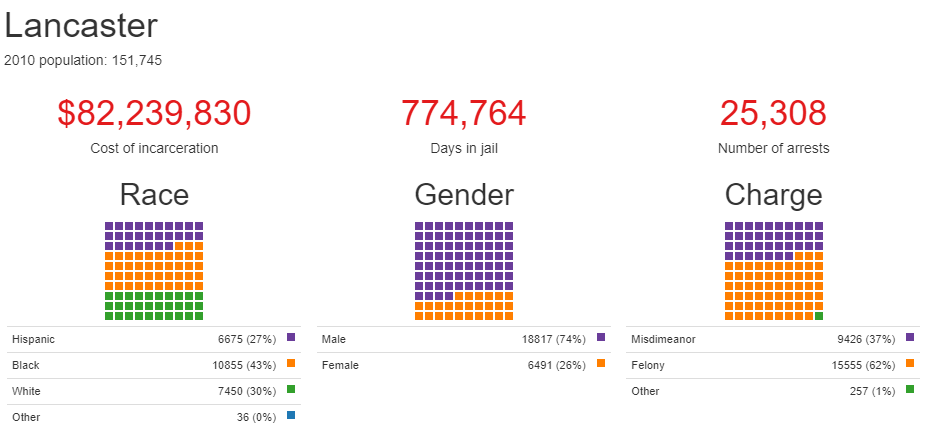
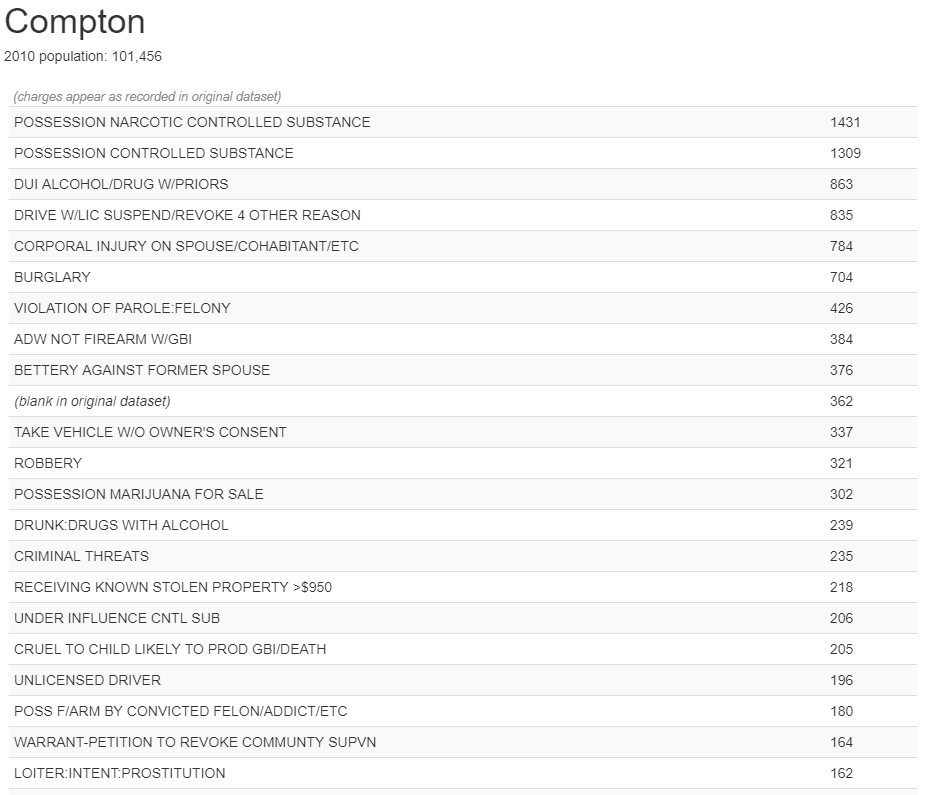
The project uncovered that LA’s nearly billion-dollar jail budget is largely concentrated to incarcerating residents of just a few neighborhoods. In Lancaster, Palmdale, and Compton, hundreds of millions of dollars have been spent since 2010. LA County has spent more than $82 million incarcerating residents from Lancaster and more than $61 million incarcerating people from Palamdale, with DUI and possession of a controlled substance the top two causes of arrest. In that same time nearly $40 million was spent of incarcerating residents from Compton where the top cause of arrest was possession of a controlled substance.

hoods

lancaster

compton


http://milliondollarhoods.org/maproom/