CA Crime Trends

With all the rhetoric one hears about the role of the War on Drugs and the hyper incarceration of low level, nonviolent criminals a fair assumption to reach would be that these types of offenders are the driving engine of mass incarceration in CA. This discourse however is shallow, naive, and emblematic of seeking simple answers for complex problems. One phenomena cannot explain a force as prolific and sinister as mass incarceration, although increasingly aggressive prosecutors can certainly receive a significant amount of the blame (Locked In by Professor Pfaff dives into this issue at great lengths).

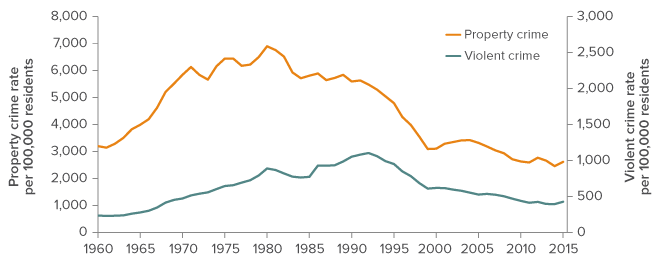
When analyzing crime trends it becomes readily apparent that violent crime has always been central to contemporary prison growth in CA. Violent crime as a category is composed of four offenses; murder & non-negligent manslaughter, forcible rape, robbery, and aggravated assault. Given the proliferation of firearms it’s fair to assume the majority of these crimes, especially robberies, murders, & assaults, are committed with guns present (which trigger sentencing enhancements). With this qualification in mind, from 1960-80 CA’s violent crime rate jumped from 236 to 888 violent crimes per 100,000 residents – an astonishing 276% rise. After a brief decline in the mid 80’s the violent crime rate rose to an all-time peak in 1992 of 1,104 per 100,000. Since then the violent crime rate has subsided substantially, and despite recent upticks in 2012 and 2015, it has remained steady at levels recorded in the 1960’s.

Property crimes have fluctuated more wildly than violent crimes over the past 50 plus years in CA. Property crimes include; burglary, larceny, theft, motor vehicle theft, shoplifting, and vandalism. It’s a rather large category that is brought together under thembrella of obtaining/destroying property using illegal means. The 2015 property crime rate of 2,620 per 100,000 residents is up 6.6% from the half-century low point of 2,459 in 2014. Similar to violent crime, property crime increased drastically between 1960-80 – from 3,140 per 100,000 residents in 1961 to an all-time peak in 1980 of 6,900 per 100,000. But the property crime rates then fell in the 1980’s & 90’s, as Baby Boomers aged out of peak criminal years, and by 2011 it was down almost 63%. Of all the reported property crimes in CA in 2015, 65% were larceny thefts, 19% were burglaries, and 17% were auto thefts.

CA crime trendz


There are 58 counties in CA so there are 58 different rates of criminal activities. The lowest rates of both violent crime and property crime in 2015 were in small rural Sierra counties & on the South Coast (which includes San Diego, Orange, and Ventura counties – relatively affluent regions).  Property crime rates in these two regions were 1,798 and 2,085 per 100,000, respectively; violent crime rates were 348 and 283. CA’s highest rates of property and violent crime were in the comparatively poor San Joaquin Valley, at 3,245 and 574 per 100,000. The crime category that varies the most widely across regions is robbery: in 2015, the robbery rate in the Bay Area (179 per 100,000) was almost six times higher than the rate in the Sierras (32). The highest auto theft rates were in the Bay Area (557) and the San Joaquin Valley (532), while the lowest rates were on the South Coast (280) and in the Sierras (176). The graphic below highlights the violent crime & property crime rates in 15 counties in 2015:

trends.PNG


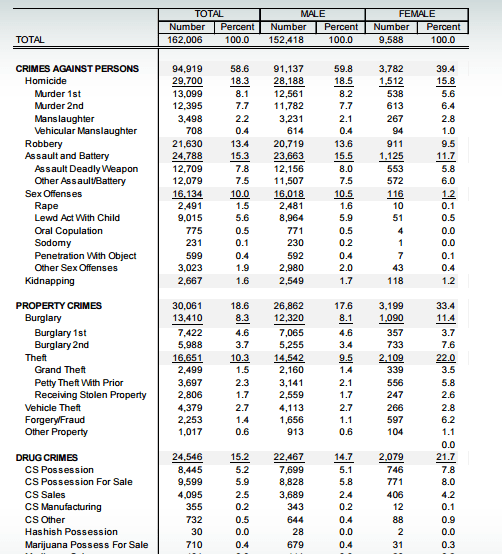
The meta narrative that CA prisons are filled with low level, non violent offenders loses muster when one examines the empirical data. This blogger doesn’t deny the impact of the War on the Drugs and the over policing of communities of color for trivial offenses, but one simple look at the breakdown of the offenders in CA prisons paints a different picture. The chart at the bottom highlights that nearly 60% of inmates in CA prions are incarcerated on violent offenses while only 15% are locked up for drug offenses. Misguided understandings of Mass incarceration plague popular accounts of the issue. Drug offenders are 15% of the institutional populations but engender 85% of the conversations. The longer we focus on these offenders the longer it will take to address the greater problems. #StayWoker


CDCR stuff

Let’s talk about Prop 47

Prop 47 is a really, really good piece of legislation. The official name of the prop is the Reduced Penalties for Some Crimes Initiative and was passed by CA voters in November of 2014. Prop 47 injected some much needed reform (some might say common sense) into the management & classification of penal sentencing codes. In a nutshell Prop 47 re-classified ‘non-serious, non-violent crimes’ as misdemeanors instead of felonies (unless the offender had prior convictions for violent crimes & sexual offenses). Even more appealing is the re-sentencing clause that was built into Prop 47 that allows inmates currently serving a prison sentence for any of the offenses that the initiative reduced to misdemeanors to petition for immediate relief. The figures vary, but safe estimates conclude that roughly 10,000 inmates were eligible for resentencing under Prop 47 guidelines. In order to assuage the visceral fears that thousands of inmates were soon to be released into communities across CA a mechanism for holistic risk assessment of individual offenders was also integrated into the Prop 47 platform to ensure only suitable offenders would be released. Additionally, Prop 47 founded the Safe Neighborhoods & Schools Fund to funnel savings from this reduction of prison populations into various other channels. As is the case with any large scale estimations figures vary, but approximately $150-$250 million in savings per year have been allocated for the Department of Education, the Victim Compensation & Government Claims Board, and other governmental entities.

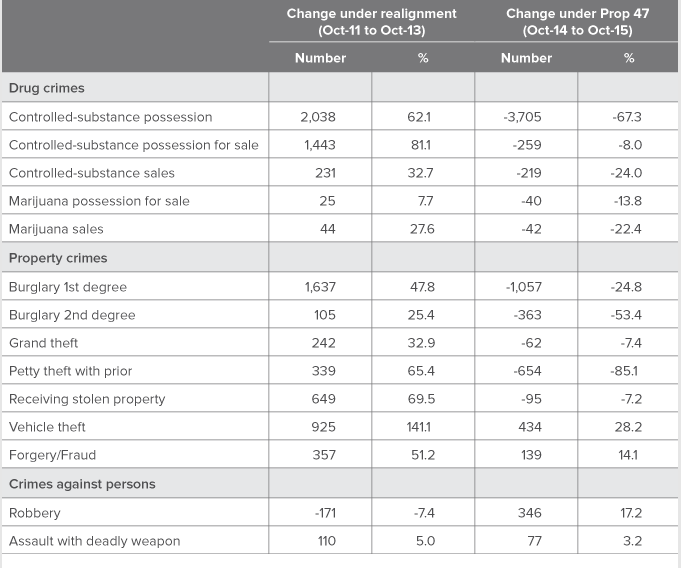
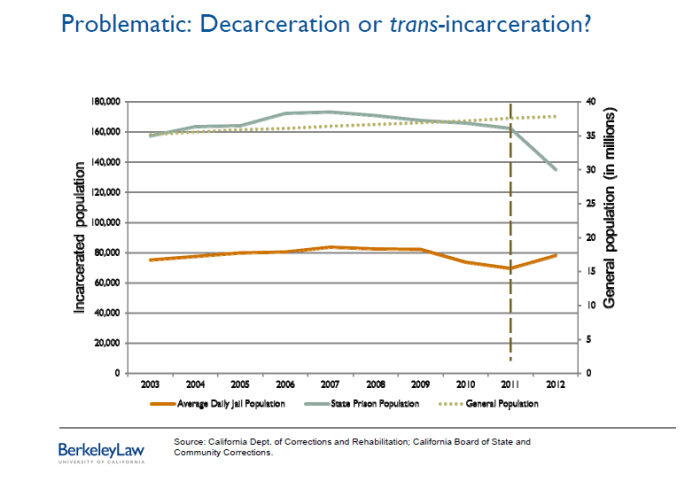
With this baseline information alone it would strike most prudent observers that Prop 47 is indeed a really, really good piece of legislation. But hold your horses folks because it gets even better when placed in the context of the post Realignment correctional climate. Realignment put considerable (and deliberate) strain on jails that were already functioning as multipurpose institutions. After Realignment jails became the singular destination for a large number of drug and property offenders who could no longer be housed in prisons, along with probation and parole violators who similarly could no longer do time at prisons. As one would expect Realignment had immediate impacts on jail populations causing them to rise at a dangerously unsustainable rate (a phenomenon Anjuli Verma has dubbed ‘trans-incarceration’). By June 2014, 3 years after Realignment and five months prior to Prop 47, the majority of county jails were at or above 90% of their relative capacity. The statewide jail population spiked at 83,280 which was just below the all-time high of 84,046 reached in 2007. After the passage of Prop 47 the jail population immediately dropped by 11% from 82,005 to 73,253 in 4 months.

Prop 47 data

To summarize, Prop 47 reduced the penalties associated with certain offenses that in turn reduced the number of lower-level drug and property offenders in custody that, to a certain extent, offset the large influx of such prisoners into jails from prisons. From the time Prop 47 was passed in November 2014 to October 2015, the volume of inmates held for property offenses decreased by 13% and the amount held for drug offenses dropped 35%.

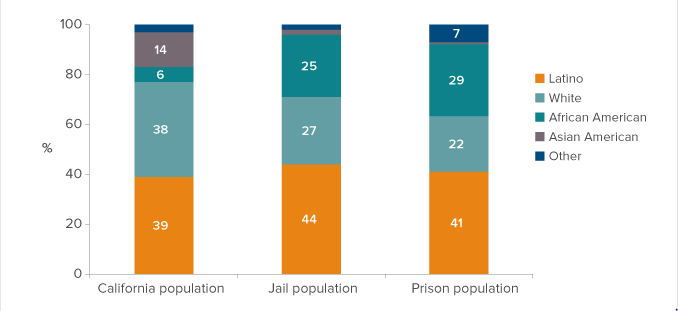
For all the good that can be attributed to Prop 47 one crucial area of correctional reform was not addressed. It is the elephant in the room for any conversation & action guided towards reform efforts. Minority over representation is still as prominent as ever in the post prop 47 era. Despite the dramatic changes to the composition of offenders in jails, the demographic breakdown remains largely unchanged. People of color continue to be the majority of inmates housed in jails.

minorities in corrections


Realignment caused an unprecedented shift in custodial responsibility that threatened to destabilize county jails across CA. Prop 47 helped mitigate the blowback and demonstrates that sometimes voters do get things right when it comes to commonsense criminal justice and prison reform efforts. Prop 57, passed in November 2016, offers a parallel potential to fuel sensible reform efforts. Perhaps this blogger will revisit Prop 57’s impact once comparable data is available.

8 Books to Read on Mass Incarceration & the Criminal Justice System

This blogger firmly believes the first step to concrete prison reform efforts is education. If we have misguided notions about the root causes of mass incarceration subsequent reform efforts will be cursory & ineffective. For example, if we uncritically accept the common narrative that the majority of people are incarcerated on petty drug crimes we will aim our endeavors at tackling this avenue solely. But upon closer inspection only 16% of state prisoners are incarcerated for drug charges. Or if we inculcate the story that private prisons are to blame for the growth of mass incarceration we miss the observation that only 2% of CA prisoners are held in private prisons (and only 8% nationally). The reality remains that the single largest group of prisoners who enter prison walls every year are recidivists (parole violators). This trend has been remedied in CA under Realignment, but remains prominent in almost every other state. With this framework in mind, here are 8 suggestions for books that contextualize the urgency of prison & criminal justice reform:

Ghettoside, Jill Leovy

Black men in America represent 6% of the population, but account for 40% of homicide victims. In this book, which will bring you to tears if you have any semblance of a soul, Leovy traces this phenomenon and searches for the fundamental causes. The reader follows the story of a few LAPD homicide detectives as they deal with overburdened case loads and few resources to alleviate the strain. The only detective who lives in the South Central neighborhood he patrols watches his son senselessly murdered a few blocks from their home. The narrative of the book follows the subsequent investigation, trial, and sentencing while sprinkling in other relevant story lines.

Leovy’s analysis leads to a startling realization; namely that the black homicide problem is a problem of human suffering caused by the absence of a state monopoly on violence. It’s a striking thesis to reach because it directly challenges the popular argument that urban communities of color are often over-policed.  Leovy juxtaposes this claim with her revelation that these communities are inadequately policed (given the low clearance rate on homicide cases). Since the law doesn’t value black lives highly the community internalizes this and reproduces a bleak self-image. Leovy convincingly argues that autonomy in turn counters homicide. This book is a three-hundred page reminder that Black Lives (and Black Minds) Matter.

Locked In, John Pfaff

In striving for meaningful prison reform one must first understand the institutional forces that shape mass incarceration, and there is no better place to begin a seminal understanding of this topic than this book. Locked In allows readers to delve deeper than the superficial tides of understanding that beseech common portrayals of mass incarceration. Pfaff challenges Michelle Alexander’s claim in The New Jim Crow that the failed War on Drugs, ill-advised sentencing laws, and the private prison complex have driven the decades-long surge in our prison population. He points out the overlooked culprits of mass incarceration (ahem, prosecutors we’re looking at you), while also paving a path for lasting reform. Reform, in his eyes, will mean re-evaluating how we deal with people convicted of violent crimes given that roughly ~60% of inmates are incarcerated on such charges. Locked In is a concise and cohesive work of legal scholarship that should be a prerequisite read for anyone discussing prison reform in the twenty-first century.

23/7 — Pelican Bay Prison and the Rise of Long-Term Solitary Confinement, Keramet Reiter

It is truly horrifying to ponder about the treatment of inmates kept in solitary confinement, and yet this work dedicates three hundred pages to just that. Reiter examines the creation of Pelican Bay Prison, the first carceral institution devised exclusively to house all inmates in solitary confinement. This panopticon design on steroids fueled by Californian penal exceptionalism is the ultimate illustration of a system that is not broken, but is functioning just as it was designed to. Reiter notes the arbitrary factors that can lead to CA prisoners being housed in solitary like gang membership. (75% of CA prisoners identify as gang-affiliated).

The social distance between the prisoner and citizen is profound, but it is even more exasperated by inmates in solitary lock up. Human beings at Pelican Bay spend 23 hours a day, 7 days a week in a tiny cell with no external stimuli at all. The UN has declared that a duration of solitary confinement for more than three weeks constitutes a human rights violation, but in CA there are prisoners who’ve spent 40 plus years in solitary confinement. The accounts from men incarcerated in such conditions are harrowing. One man describes it as being put into a tiny pod and shot into outer space with nothing to survive on. 23/7 paints a vivid picture of solitary confinement that one will not easily forget.

Golden Gulag — Prisons, Surplus, Crisis, and Opposition in Globalizing California, Ruth Wilson Gilmore.

It’s impossible to overstate the importance of Golden Gulag in shining an inquisitive light on the biggest prison-building project in the history of the world. Gilmore provides an extremely detailed look at how CA became the international carceral anomaly that is. CA has built 22 prisons, but only 1 UC Campus since 1980 which has produced a disposable sub-culture of Californians targeted by the tentacles of the criminal justice system. Gilmore describes the expansion of prisons in CA as “a geographical solution to socio-economic problems”. The rise of the prison industrial complex in CA, in Gilmore’s eyes, was a series of developments in response to surpluses of capital, land, labor, and state capacity. This book is a dense read at times, but one will come out on the other side with a more nuanced understanding of mass incarceration that escapes most who talk about the issue.

Crook County — Racism and Injustice in America’s largest Criminal Court, Nicole Gonzalez Van Cleve

Crook County leaves the reader with an uneasy feeling about the role of courts in dispensing justice in America. Gonzalez Van Cleve, a professor at Temple University, spent ten years conducting ethnographic research in the largest criminal courthouse in the country, and her findings confirm that idealized depictions of courts as impartial and sacred institutions is little more than a mirage. The legal world revealed in Crook County shows how inherently damaging the “colorblind” rhetoric truly is. Parallels to Jim Crow racial tropes abound when prosecutors and judges stop being polite and start getting racist. This book communicates how Courts, the gateway between policing and incarceration, operate in a racially skewed manner that is so insidiously unfair that it undermines the integrity of constitutional protections for fair trials. This blogger had the opportunity to attend an event at UC Berkeley before Crook County was released with the author that positively excited this student beyond recognizable reason.

Mass Incarceration on Trial — A remarkable court decision and the future of prisons in America, Jonathan Simon.

Professor Simon, one of the leading scholars on mass incarceration in the world,  offers a poignant account of how mass incarceration is innately unconstitutional. The conditions in which CA prisoners lived was so degrading that it forced the Supreme Court to remand CA into instituting population caps.  In the memorable opinion Justice Kennedy stated that, “Prisoners retain the essence of dignity inherent in all persons.” Quite the contrast from CA which had spent the previous forty years stripping prisoners of every last shred of dignity. Professor Simon theorizes that this recent case and future challenges will result in a “dignity cascade” in which the rights that have been denied for so long will come rushing back and will inform future incarcerate policy decisions. Mass Incarceration on Trial is highly accessible and easy to digest despite it’s technical backdrop, a testament to Professor Simon’s eloquent writing style. This blogger must admit an inherent bias as a student of Professor Simon at UC Berkeley, but it remains nonetheless as a great introduction for those curious just how rotten CA prisons were, and still are.

Are Prisons Obsolete? Angela Davis

Angela Davis takes a sledgehammer to the social control underpinnings of mass incarceration and unflinchingly destroys every aspect of the odious system. Davis asks a fundamental question, why do we accept prisons as inevitable and permanent features of our lives? She confronts the reader to challenge inner convictions on why one signs off on a system that relegates large numbers of people from racially oppressed communities to an isolated existence marked by authoritarian regimes, violence, disease, and technologies of seclusion that produce severe mental instability.

Davis dedicates a portion of the book to addressing the invisible issues women in prison face. There are currently more women in prison in CA now than there were in the entire country in the early 1970’s. CA is home to the two largest women’s prisons in the world — and they are literally across the street from eachother in Cowchilla. This work is short, sweet, and gets right to the point. There is no surplus in this book, and one will leave with an enduring hope for prison abolitionist movements in the twenty-first century.

Just Mercy, Bryan Stevenson

Just Mercy is a semi-autobiographical novel that follows the story of a lawyer valiantly litigating capital punishment cases in Alabama. The stories one encounters while reading this book illustrate how easy it is for the system to railroad innocent lives and condemn them to death. Stevenson, one of the most brilliant lawyers of our time, provides an unforgettable true story about the underrated potential for mercy in law. Just Mercy pulls on the heart strings but leaves one with a great appreciation for social justice organizations across the country.
How did CA complete the largest prison building operation in human history?

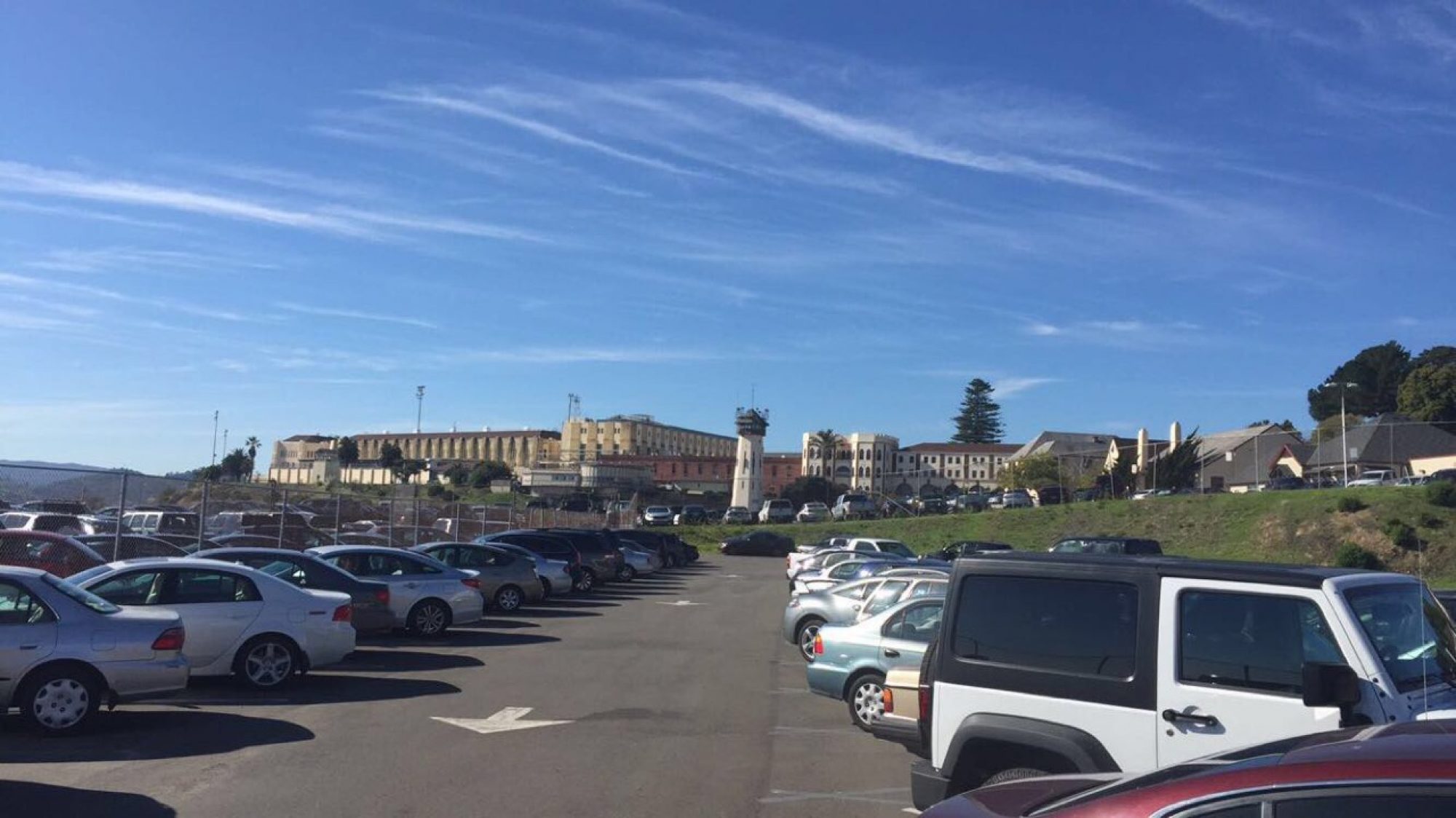
Prisons are taken for granted nowadays. They function as nearly invisible institutions in society although they are allocated massive amounts of resources and serve as human landfills for hundreds of thousands of Californians. But it wasn’t always this way; as recently as ~40 years ago CA had a rather modest prison population. The boom in per capita incarceration rates is well documented, but the construction of prisons to confine all these individuals is not. The short answer is this rapid expansion of the carceral state was developed with little legislative or judicial oversight. The long answer requires a nuanced understanding of the political & economic factors that facilitated funding, specifically the proliferation of lease revenue & general obligation bonds, and the perceived absolute need for more prisons by bureaucratic actors despite falling crime rates.

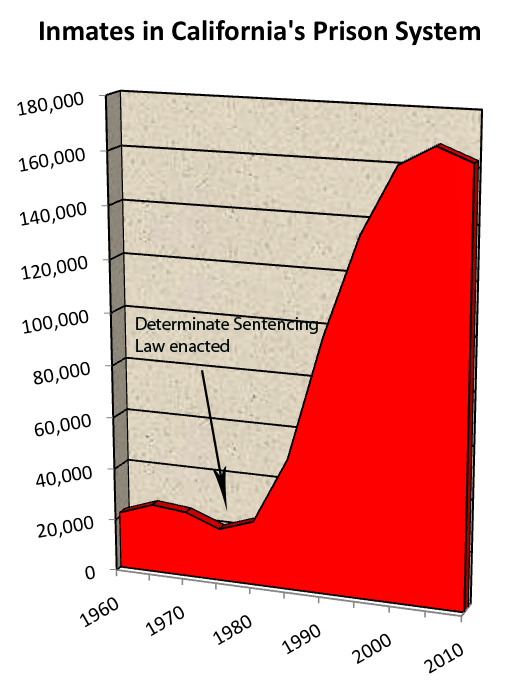
Ruth Wilson Gilmore, author of Golden Gulag: Prisons, Surplus, Crisis, and Opposition in Globalizing California, co-founder of Critical Resistance — a profoundly important prison reform organization, and one of my favorite socio-legal scholars, shined a much needed light on CA’s ambitious prison construction plan. As she writes, “Consistently, from 1982 to 1996, the CDC (now CDCR) had six to ten new prisons in some stage of planning, design, or construction, at an average cost per establishment of a quarter billion dollars.” Why did CA feel there was a need to undergo such an historically unprecedented prison building program? Were CDCR officials expecting a continuous uptick in incarcerate commitments and reacting appropriately to the demand of a 450% increase in incarceration rates? There are of course no simple answers, but momentum leads in the direction of the 1977 Uniform Determinate Sentencing Act. This law, signed by Governor Jerry Brown during his first governorship, shifted the rationale of punishment and incarceration from rehabilitation to a force of unrelenting incapacitation. The language of the law plainly states, “The purpose of imprisonment for crime is punishment.” The Determinate sentencing act locked inmates into their sentences for its entirety and abolished the role of parole boards in early releases. This change in penal sentencing law intersected with the War on Drugs, the infamous Three-Strikes law, Mandatory minimums, and other sentencing enhancements like gang membership to effectively spur mass incarceration as we know it today.

prison-pop-graph

CA corrections officials had a new mission statement; to confine inmates for their entirety of their sentences as a punishment for their crimes. By removing rehabilitation as a guiding rationale the perfect storm for a colossal prison construction operation was brewing on the horizon. The need for more detention facilities brought the challenge of funding these expensive entities. The path of least resistance manifested itself in the use of tax payer money to finance the endeavor. In 1982 the CA legislature successfully convinced voters to approve the Prison Construction Bond Act that authorized $495,000,000 in general obligation bonds to build new prisons. The argument was framed to mobilize voters fears by equating more prison cells to improved community safety. But politicians were weary of relying on voters to approve numerous general obligation bonds. As Gilmore writes, “The problem became how to expand a politically popular program (prisons) without running up against the politically contradictory limit to taxpayers’ willingness to use their own money to defend against their own fears.” The solution was a loophole in municipal bonding known as Lease Revenue Bonds. Lease Revenue Bonds allowed prison bureaucrats to borrow huge sums of money to fund new prisons while doing so off the books because their repayment didn’t require any additional taxing or fiscal capacities of the state. Lease revenue bonds and general obligation bonds operate in similar fashions, the only real differences being the depth of approval needed to borrow and amount of interest that is racked up (lease revenue bonds entail higher interest repayments because the state is not liable.)

Data from the State Public Works Board of CA shows that the amount of debt for the prison construction program grew from $763 million to $4.9 billion dollars from 1985 to 1993, representing a proportional increase from 3.8% to 16.6% of CA’s total debt. This new influx of capital paved the foundation for CA to undergo the largest prison building operation in human history. The next step became where to site all the new prisons, but more on that on a later post …

Consequences of compliance: Trans-incarceration in the aftermath of Brown v. Plata

We are 5 and half years removed from one of the most important Supreme Court decisions of my young lifetime. Brown V. Plata, handed down May 2011, ordered California to reduce prison overcrowding to a constitutionally permissible level of 137.5% above design capacity. (CA prisons had been operating around 200% above design capacity). CA prisons had become so overcrowded they were failing to provide adequate, basic, — or even any, healthcare to prisoners. As federal judge Thelton Henderson examined, “The harm already done in this case to California’s prison inmate population could not be more grave, and the threat of future injury and death is virtually guaranteed in the absence of drastic action … Indeed, it is a uncontested fact that, on average, an inmate in one of California’s prisons needlessly dies every six to seven days due to constitutional deficiencies in the CDCR’s medical delivery system. This statistic, awful as it is, barely provides a window into the waste of human life occurring behind California’s prison walls due to the gross failures of the medical delivery system.” The lack of accessible healthcare to inmates had become another unconscionable feature of CA’s prisons crisis. The opinion of the Supreme Court noted that “prisoners retain the essence of human dignity inherent in all persons.” The stage for compliance was set, CA had to re-inject human dignity into the treatment of the carceral population while simultaneously remedying constitutional violations against cruel and unusual punishment. The strategy for compliance however wasn’t concerned with confronting these human rights violations, but rather shifted the burden of incarceration to county level jails for those convicted of non-serious, non-violent, and non-sex registerable offenders, as well as those who violated terms of their parole or probation. Local jails however were not equipped with better health care resources, in fact it may be said they are even less prepared to deal with influx of thousands of new prisoners. Jails function as pre-adjudicatory confinement centers, for those who can’t post bail, and usually incarcerate misdemeanor offenders on sentences of less than 12 months. Due to the relatively short stay of inmates in country jails the facilities don’t have expansive medical units. So CA complied to the Supreme Court decision condemning their lack of adequate health care by sending thousands of inmates to facilites that don’t have adequate health care systems. Hmm. Does this seem like a sustainable trend? (The answer is no, folks.) All the while this strategy of Correctional Realignment was touted as progressive and helping to facilitate trends of decarceration statewide. But as the graphic below shows, this trend is more aptly described as trans-incarceration, not decarceration. (graph courtesy of Anjuli Verma, Ph.D.) CA merely kicked the can down the road to get the Supreme Court of their back. Ideally, this would have been a perfect opportunity to re-evaluate our prison system and pursue alternative incarceration policies. Alas, reform was put on the back burner as CA trimmed around the edges of mass incarceration without tackling the underlying issues.trans-carceration