
John Chiang is the real deal

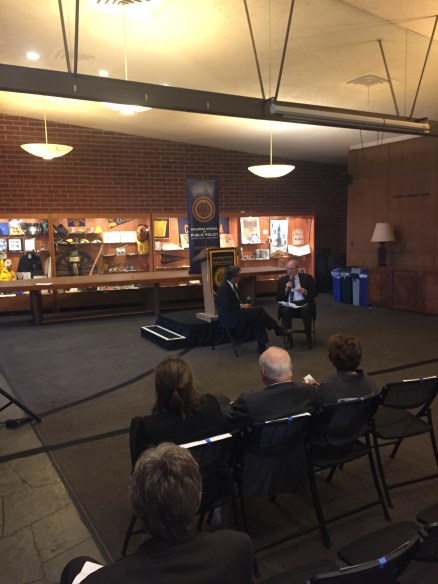
Previously, we took a cursory look at what the top candidates for CA governor in 2018 think about the criminal justice system. To summarize, it was rather underwhelming. John Chiang, current Treasurer, was the wildcard of the group with little accessible information available on his views. Recently, this blogger had the privilege of attending a lecture on the UC Berkeley campus in which Chiang shared his various policy positions. It is immediate clear to observers that Chiang really, really knows what he’s talking about. Unlike other desultory politicians who tend to harp on superficial buzzwords to generate awe, Chiang comes off as informed, sharp, and acutely aware of the barriers to prison reform in CA.

Chiang started his conversation going in depth about what has driven CA to become the 6th largest economy in the world. But despite all of our economic might, 1 in 5 Californians live in poverty. What good is this status if cyclical entrenched poverty cripples communities and severely restricts upward mobility? When prompted to speak on his vision for CA in 2018 if elected, he responded by mentioning the pressing need to address income inequality. He was off to a good start and didn’t slow down.

More impressive was his knowledge about the Correctional climate in CA. Mass incarceration is profoundly expensive, but invests very little in prisoners. It’s an extraordinarily poor return on our investment when 7/10 prisoners return to prison walls within three years of release. In order to get more bang for our taxpayer buck, Chiang emphasized the ‘R’ in CDCR (Rehabilitation). He dived into why incarceration is so expensive and correctly identified healthcare for aging prison populations as a huge factor. The fiscal ramifications of having to provide adequate healthcare for prisoners in their late 50’s, 60’s, and 70’s drove him to advocate for reevaluating sentence structures. We are locking up and forgetting about these souls, but our pockets aren’t forgetting about them. As these individuals get older and reconsider their lives, how long should they have to pay for actions as a young adults? Chiang elegantly zeroed in on the pragmatic approaches for second chances.

He concluded by pointing out that correctional reform is small fish, for if we really wanted to reform our prison system we’d be investing more in earlier resources like K-12 education so there wouldn’t be such a massive need for human caging in CA. Targeting the front end and disrupting the prison pipeline is the real key to prison reform, not hemming around the edges by pursuing low-hanging reform fruit. He connected his prison reform arguments to his earlier positions that until income inequality is remedied, prison reform can never be fully actualized. CA would be lucky to have Chiang steering the ship in 2018 and beyond. #Chiang2018

IMG_3108.JPG

Update on the future of the Death penalty in CA

Earlier, we took an in depth look at the contours of capital punishment in CA. As we awaited challenges to the constitutionality of Prop 66 to be clarified by the CA Supreme Court, this blogger predicted that capital punishment would be upheld but the five year cap on the appeals process would fail to survive judicial scrutiny. As it turns out, that prediction was pretty accurate. In typically ambiguous legal language, the CA Supreme Court declared the five year deadline as a mere ‘directive, not a requirement’. For 731 inmates on CA’s death row population, this means their appeals process will continue at a glacial pace and they won’t be headed to the gas chamber any time soon. But for the remaining 15 condemned souls who’ve exhausted their appeals, this means only Governor Brown can save them from death. Whether Brown chooses to commute their sentences remains to be seen, but he didn’t take a public position on Prop 66 last November. Rumors have spread that Brown is deeply opposed to capital punishment due to his Jesuit upbringing, but until he acts, a deadly game of wait and see will play out in CA.

Is mass incarceration a necessary ingredient for crime prevention?

CA has evolved to become very good at state sanctioned disappearances. Communities across the state have been swallowed whole as the tentacles of the criminal justice system reach far further than just the individual incarcerated bodies. But the current response to crime treats it as a cancerous disease that must be rooted out, as opposed to a symptom of a larger condition of human suffering. By retraining our minds to see crime through a different lens we can transcend traditional understandings of crime prevention not as a tool of social control, but as a tool for comprehending the crucial factor that leads to criminality: autonomy, or lack thereof. Ultimately, identifying mass incarceration’s hermeneutic location is key to forging social change.

A quick glance at CA crime trends demonstrates that over the last 20 years crime has dropped to the pre-mass incarceration levels of the 1960’s. The normative assumption that crime is going down because prison admissions are increasing makes sense on a static and superficial level, but since crime is low in CA society it begs the question as to why prison admissions are still growing? After 40 unrelenting years, CA has grown comfortable relying on incarceration as a catch all mechanism for correcting societal ill’s. Whether one thinks law enforcement agencies should be in the trenches interacting with a wide array of issues ranging from poverty, addiction, and/or mental health is a different conversation, but highlights where CA has placed its resources. Incarceration as a blunt instrument is akin to trench warfare in World War II. No progress is achieved, but the body counts rise at chilling rates. History teaches us that CA trusts its mass incarceration process.

The ‘smart on crime’ discourse betrays original thought, but illuminates a plethora of alternative approaches to crime prevention besides mass incarceration. As Attorney General, Kamala Harris targeted truancy as a problematic indicator of future problems and sought to aggressively reverse the trends she was observing. Students who don’t go to school consistently are at danger of falling behind, and those who fall behind are more likely to drop out (nationwide 82% of prisoners are high school dropouts). Instead of greasing up the prison pipeline, Harris sought to disrupt the flow in a tangible way. This is good policy, folks. Restorative justice also offers an exciting avenue of reform that focuses on healing the relationships destroyed by crime. Unlike the criminal justice system, restorative justice emphasizes the agency of victims in directly participating in the resolution process. Beyond that, this model recognizes that individuals are not inherently violent, but may have simply engaged in violence at a particular time. Humans make mistakes, but deserve a shot at life after life.

While these policy positions are certainly a step in the reformist direction, the elephant in the room remains the social forces that drive individuals to crime. Beyond seeing mass incarceration as the alive-and-well legacy of slavery, there are confounding economic issues that contribute to creating a disposable sub-class of citizens primed for entrance to the criminal justice system. Surpluses from capital, labor, land, and state capacity have driven the prison expansion movement in CA. The economy is unforgiving for those who don’t have skills, and CA does an exceptionally poor job of preparing its most important assets — Californians — for a life of upward mobility. The last thing you want is for people to feel like they don’t have anything, because people who have nothing will do anything to get something. Inserting autonomy into communities that are black holes is difficult, but increasing access to basic features of the middle class — education, healthcare, food and housing security — is the foundation that must be laid. A minuscule percentage of CA prisoners are incorrigible psychopaths, the vast majority can be lumped into those who didn’t have access to the benefits of a middle class existence. In the words of John Stuart Mill, “He who chooses his own plan for himself employs all his faculties.” It seems safe to assume that Californians would rather live in a welfare state than a police state.

Complacency in this moment of mass incarceration is the tyranny of the majority. As long as we see incarcerated Californians as the ‘others’ in society, we won’t be able to tackle mass incarceration as the problem of human suffering that it is. One doesn’t need to be directly touched by injustice to fight against it. Until the privileged are more outraged than the oppressed there will be no justice in CA.

The shadowy domain of sentence enhancements

CA leads the nation in adult and juvenile life sentences. Most observers might assume life sentences derive from murder charges, but the majority of these sentences involve enhancements — certain factors that automatically trigger longer criminal sentences. Judicial discretion is removed from the equation of enhancements, so even if a judge favored leniency, they have no authority to act on such inclinations. There is an empirical gap in assuming harsh enhancements deter crime and evidence that supports such a theory. Ultimately, enhancements come down to fear & preservation of public safety, two seemingly innocent positions, but ones that combined with several other factors to produce hyper incarceration in CA.

The notorious Three Strikes sentencing law is certainly the most well-known enhancement, but its been altered and scaled back since Prop 36 in 2012. Gang membership, gun possession, and prior drug charges are among the most common enhancements applied in CA courtrooms. In most cases, these enhancements are served consecutively, not concurrently.

Gang membership is liberally enforced, but for reasons that may amount to nothing more than racial profiling. In 2000, Prop 21 (one of the harshest criminal justice voter initiatives), built on a 1980’s gang crime bill by designating a plethora of additional charges manifesting from gang activity. Prop 21 increased extra prison terms for gang-related crimes to two, three, or four years, but if serious or violent crimes were at play, the new extra prison terms would be five and ten years. For example, if a gang member were to be found guilty of theft, they would be sentenced for the theft plus an enhancement of 2-4 years for being gang affiliated. Simple gang association was also criminalized and subject to enhancements. Participating in a crime with a gang member means that one could be found guilty for a certain offense & an enhancement would be added to the base sentence if gang ties are suspected. It’s not difficult to understand how sentences began growing in duration under this sentencing framework. To correctly identify these gang members for enhancements, databases were established that require convicted gang members to register with local & state law enforcement agencies. But the markers of gang membership commonly boil down to race, clothing, and neighborhood. To state the obvious, young men of color bore the brunt of this tactic. A 2015 law review article exposed the rampant injustices proliferating from gang enhancements. Prosecutors devise methods to build gang enhancements (*ahem* racial profiling *ahem*) in a legal culture in which prosecutorial success is measured by the lengths of prison sentences they obtain. Even for those who are in gangs, there is little reason to believe enhancements deter gang membership. The root cause of gang membership may be said to be protection, or for a sense of belonging, two factors that are not remedied by enhancements.

Under CA gun laws, a sentence for a felony can be enhanced if a gun was possessed or used by an offender or an accomplice during commission of the crime. In such a case, the sentence for the underlying felony can be made longer — in some cases, much longer. The additional time racked up from gun enhancements (from one year to life) depends on:

  • the type of firearm or weapon involved,
  • whether one or another person involved with the crime used the gun,
  • whether one used the gun or simply had it with it on their persons,
  • the underlying felony offense, and
  • criminal history.

In cases in which one or more gun enhancement is relevant, the enhancement that carries the longer potential prison term of imprisonment is applied. When a gun is used in a serious felony the ’10-20-life use a gun and you’re done’ rule is triggered.

  • 10 years in prison for “using” a gun,
  • 20 years for firing a gun, or
  • 25 years to life for killing or seriously injuring another person with a gun.

The enhancement is in addition and consecutive to the sentence for the underlying felony conviction.

img-use-gun-done-optimized

Drug enhancements delve into a more complex humanitarian issue — the criminalization of addiction. Under current CA penal law, a person convicted for sale or possession of a small amount of drugs can face a sentence of three to five years incarceration, plus an additional three years in jail for each prior conviction for similar drug offenses. The CA legislature is currently working to eliminate this particular drug enhancement, but the treatment of drug addiction remains a problematic strain on the criminal justice system.

Absent from this discussion of enhancements has been the prevalence of mandatory minimums in CA penal sentencing laws. When one considers the conglomeration of sentencing mandates, the force of mass incarceration becomes painfully transparent. But with this transparency comes simple avenues for reform. Eliminating enhancements is low-hanging fruit in the realm of prison reform, but would reap immediate benefits. Certain enhancements, like those for repeat sex-offenders need not be addressed, but gang enhancements are an obvious target for reform. Perhaps looking to the global community would help inspire meaningful corrective legislation.


Update on CA’s Bail reform efforts

As detailed in an earlier post, CA’s criminal bail system is so insidiously unfair that it’s better to be guilty and rich than innocent and poor. A person’s ability to get out of jail depends on the size of their bank account. In many ways, the current bail system mirrors the structural inequalities in society — the well off enjoy privileges in an elevated social class divorced from life in the middle and lower classes. The good news is that a robust reform movement is underway and quickly gaining steam.

Replacing wealth based decisions on pre-trial detention to an individual impact on public safety assessment tool is the gist of the bill making its way through the CA legislature. The commercial bail industry in CA, valued annually at roughly $2 billion, has already spent $170,000 on lobbying efforts to oppose changes to CA’s bail system.

Nationwide, the majority of people unable to meet money bail fall within the poorest third of society. Criminalizing poverty has extensive historical roots, but modernizing the pretrial system offers the possibility to address one of the major humanitarian injustices permeating CA’s criminal justice system. In CA, 63% of people caged in jails are legally innocent and awaiting trial. Governor Brown’s compliance to a Supreme Court population cap mandate shifted facility overcrowding from prisons to jails, but if the legislature can pass the Bail reform bill it will greatly alleviate jail overcrowding.

Communities are healthier and safer when they are whole.