
The uncertain future of the death penalty in CA

CA has the largest death row population in the Western hemisphere. There are 749 inmates awaiting death, but there hasn’t been an execution since 2006. There would have to be more than one execution, every day, for two years to empty death row. To deal with this issue CA voters were faced with two incompatible initiatives last November to determine the fate of capital punishment. Prop 62 sought to abolish the death penalty, while Prop 66 sought to expedite the process. Prop 66 won by less than 30,000 votes, while Prop 62 lost by a more sizable margin of 850,000 votes.

Prop 62 would have brought CA in line with the rest of the developed world in abolishing capital punishment. It would have repealed the death penalty and replaced it with LWOP as the maximum available punishment for murder. Prop 62 would have retroactively applied to inmates on death row and thus would have eliminated it entirely. In 2012, a similar initiative to abolish the death penalty, Prop 34, lost by approximately 500,000 votes. These recent results demonstrate the majority of CA voters aren’t interested in extracting the ultimate manifestation of retribution from the criminal justice system.

Prop 66 vows to keep the death penalty in place while tweaking the procedures that govern the administration. Prop 66 seeks to speed up the appeals process (currently capital punishment appeals take upwards of 25 years) to a condensed 5-year cap. The day after Prop 66 was passed litigation was filed to block the implementation arguing that the initiative was unconstitutional. The crux of the legal argument is that a 5-year cap is not logistically possible and would lead to further injustices. Lawyers and Courts would be forced to cut corners in their representation and investigation to meet this timeline. The language of Prop 66 also explicitly removes the CA Supreme Court and Appellate Courts from hearing these capital punishment cases. This leads to denying habeas corpus petitions, which effectively denies inalienable constitutional rights and strips death row inmates from their full range of legal options.

The CA Supreme Court stayed the implementation a month later on December 20th. On June 6th the Court heard oral arguments in the case. The Court appears divided during arguments over whether the initiative could require a 5-year deadline for death penalty appeals. The Court has a wide array of options. The Court could strike down Prop 66 (highly unlikely given the longstanding precedence of judicial deference for voter initiatives), or they could remove certain aspects of Prop 66 like the timeline feature of strict appellate procedures. A final decision on the initiative is not expected until August 2017. This blogger had the privilege of attending a guest lecture from Associate Justice Goodwin Liu a few months back and would be very surprised to see the 5-year cap withstand judicial scrutiny.

The administration of the death penalty has changed over time. Before 1937 inmates condemned to death were hanged. 307 CA prisoners were put to death using this method. The CA legislature then changed the method of execution to lethal gas. The gas chamber was installed at San Quentin State Prison in 1938. On December 2nd, 1938 the first execution by lethal gas was conducted. From that date through 1967, 294 inmates were executed by gas at SQ. As a result of various State and Federal Court decisions there were no executions in CA for the next 25 years.

Although the death penalty was swiftly reinstated by voters in a ballot initiative in 1978, executions didn’t resume in CA until April 21st, 1992. In January of 1993, CA law changed again to allow condemned inmates to choose either lethal gas or lethal injection as the preferred method of execution. CA developed lethal gas protocols from other jurisdictions, but there is significant literature that casts a dark cloud over the supposed humanness of lethal injection. As such lethal injection has been declared to violate the 8th amendment ban on cruel & unusual punishment on several occasions since 2006.

Stories of botched lethal injections are among the most horrifying accounts to come across. Bodies convulse uncontrollably as inmates are subject to unimaginable pain. Inmates are paralyzed, but evidence suggests they feel the drugs used to stop the heart burning throughout the body.

The barbarity of modern capital punishment directly contradicts childhood lessons that two wrongs don’t make a right. Moral and practical arguments against the death penalty are equally convincing. It goes without saying, but this blogger is deeply uncomfortable with the current state of capital punishment in CA.
What do the top 2018 CA Governor candidates think about the criminal justice system?

Gavin Newsom, the perceived front-runner, has a strong track record of supporting criminal justice reform measures. He was the lone statewide politician to endorse Proposition 47 in 2014, which made nonviolent offenses like drug and property crimes misdemeanors instead of felonies. He also positioned himself as the face of the Prop 64 effort to legalize recreational marijuana for adults. Additionally he is opposed to the death penalty. This all sounds very appealing on a surface level, but the problem is that Newsom isn’t the sharpest tool in the shed. He’s the perfect American politician – tall, white, righteous, and handsome. However, nothing suggests he has transcended the superficial tides of understanding that beseech common understandings of mass incarceration. For example, in a 2016 interview he chimed in that, “The war on Drugs is a political war, not a scientific war. If it was a scientific war, it would have collapsed under its own weight years ago.”  First of all, ‘if it was a scientific war’ demonstrates a poor command of the English language (if it were a scientific war), see: Newsom, not the sharpest tool in the shed. Secondly, it’s time to move beyond maximizing the role of the War on Drugs as the main engine of prison growth in CA. Yes, Mr. Newsom the War on Drugs was a failed political war. Next will you inform voters that water is still wet? We desperately await your cutting edge analyses. Newsom is likely to win in 2018, but here’s to hoping he surrounds himself with people who understand the majority of CA inmates aren’t incarcerated for smoking pot.

Antonio Villaraigosa, former CA assembly member and mayor of LA, is the other big-name candidate in the 2018 race. As the mayor of LA he pursued an agenda of making LA the safest big city in the country. To accomplish this Villaraigosa expanded LAPD to its largest force in city history by adding over 1,000 officers. Depending on one’s experiences in life, more cops than ever is either really good or really bad policy. This blogger leans towards the really bad side of the continuum. What if Villaraigosa had sought to understand the social conditions that facilitate crime by adding 1,000 teachers and making LA the most advanced K-12 system in the country? Adding more cops deals with the back end of the problem instead of tackling the features that lead to crime in the first place. This is a common political move; mobilize voters by preying on their fear of crime instead of digging deep and having tough conversations that could reduce the need for the largest police force in city history. In a recent interview, Villaraigosa touted his progressive resume on criminal justice issues. “I was taking on prison building in 1994, when my voice was one of the few challenging the fact that we were putting more people in prison than any place in the world. And I think it’s time for us to invest in people.” Villaraigosa did, however, vote in favor of building a maximum-security prison north of Bakersfield when he was state Assembly speaker in 1999. Truth is fickle, Mr. Villaraigosa even in the current post-fact era. This blogger hopes Mr. Villaraigosa doesn’t intend to build the largest state-wide police force in CA history to show his commitment to ‘investing’ in people.

John Chiang, former State controller and current Treasurer, is the dark horse in the race. It’s difficult to find much about his criminal justice positions. His life however has been deeply affected by crime. Chiang’s late sister, Joyce, was 28 when she went missing and was found murdered. Chiang understands the ability to meet demands for smart on crime initiatives often ties back to finances and making sure there’s enough money in the state budget. “If you don’t understand the state’s finances you can’t support the programs that we so direly and deeply need in CA.” Amen to that, Mr. Chiang. It should also be noted that Chiang is the only major democratic candidate who doesn’t have an adulterous past. Respecting women and half of the electorate should probably be a pre-requisite to run for public office, but the events of November ’16 brutally rejected this notion.

As readers may observe this blogger omitted any Republican candidates for the race because, well, this is CA. It would be hard for Republicans to have any less of a voice than they currently do. Too bad for them.

Probation in CA

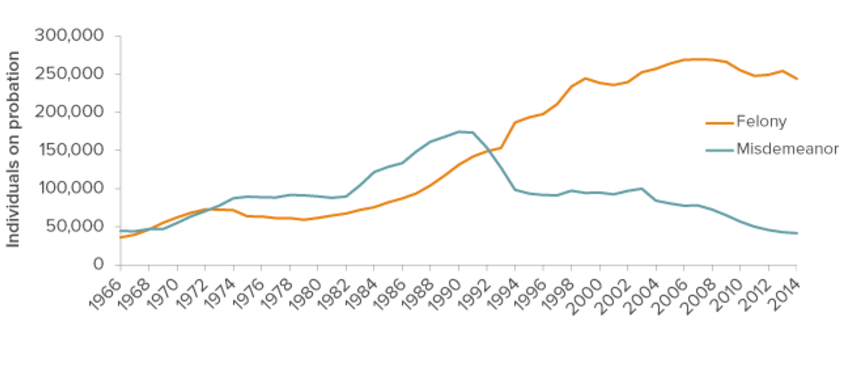
Probation is the most widely used form of correctional supervision in CA. There are three other forms of correctional supervision – prison, jail, and parole. Judges can sentence convicted offenders to the supervision of probation officers as an alternative to jail or prison. The DA, public defender, and the probation department influence judicial decisions. CA’s adult supervised probation population is more than twice the size of its prison population, almost four times larger than its jail population, and about six times larger than its parole population. Probation is also the cheapest form of correctional supervisor with average cost per offender at $4,400 a year.

Probation has been reshaped by recent reforms. Since 2009, legislation has encouraged county probation departments to keep violators under community supervision instead of returning them to state prison. Realignment in 2011 & Prop 47 in 2014 magnified this mission. As a result of these efforts, one in every hundred CA adults was on probation at the end of 2016.

CA’s adult probation caseload is down 19% from its historical high of 352,449 in 2003. The statewide-supervised caseload currently sits at 285,681. Felony probation cases account for 85% of the total caseload. The share of felony cases has shifted dramatically over time: from the 1970’s to 90’s, the majority of probation cases were misdemeanors, but by 2016 misdemeanor probation cases had declined by 76%.

probation

Since Realignment, counties have been forced to increase expenditures to meet the increasing demand for probation services. County departments spent more than $1.5 billion in 2015, nearly $400 million more than they spent in 2010. But counties are spending twice as much on jails (about $3 billion in 2015). The daily cost of supervising a probationer is roughly $12. It costs astronomically more to house an inmate in jail or prison.

It’s too soon to label this trend mass probation, but a shift from hyper incarceration to an inflated use of probation makes a whole lot of sense. It’s cheaper, allows offenders to stay in the community, and has been proven to lower recidivism. Probation is not a catch all solution to mass incarceration in CA, but offers the potential to punish with proportionality as the guiding rationale.

A closer look at Prop 57

Prop 57 has the potential to bring substantial change to CA’s criminal justice system. Prop 57 known as the “CA parole for non-violent criminals and juvenile court trial requirements initiative” passed by an overwhelming majority last November. The measure increases the chances of parole for inmates in state prison convicted of nonviolent crimes and expands opportunities to earn credits for good behavior. Relaxing parole rules will further alleviate prison overcrowding through the early release of up to 11,500 inmates over the next 4 years.

The juvenile justice system, often overlooked despite its prickly tentacles, is also addressed in Prop 57. Historically the mission of juvenile courts has been diversionary in nature rather than overtly punitive. The logic follows as such: Kids make dumb mistakes but deserve second chances because they are kids (one would be hard pressed to find other examples of common sense policies like this in the criminal justice system). The ethos of the juvenile justice system however was punctuated when charging authority was transferred from judges to prosecutors in the latter half of the twentieth century. By design prosecutors are not concerned with leniency. Prop 57 corrects this crucial mistake by restoring judicial discretion in allowing judges to decide if they want to waive jurisdiction and transfer defendants over 14 to adult courts.

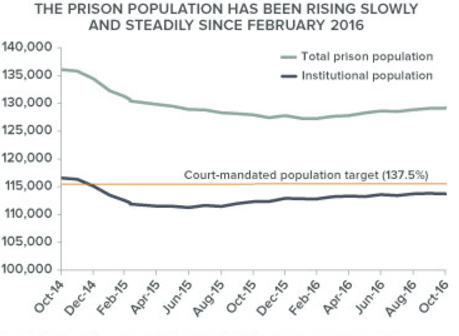
Prop 57’s impact will fall heavily on the shoulders of CDCR. It remains uncertain whether Corrections has the immediate capacity (a pessimist might say will) to provide effective rehabilitation programs. Developing and implementing new credit programs will undoubtedly take time, but new prison admission rates suggest CA can’t afford the luxury of patience. Since 2009 CA prison populations have declined by roughly 41,000. At 113,700 the current population is almost 2,200 below the court imposed cap of  staying under 137.5% design capacity. But since early 2016 the statewide prison population has been increasing on average of more than 200 new inmates each month. If this rate continues CDCR could find itself in hot water as the population will surge above the court-mandated target by late 2017.

populations

To deal with this pressing matter Prop 57 has delivered CDCR two primary tools. Inmates serving time for ‘non-violent’ felonies will be eligible for parole after serving the full term for their primary offenses, without having to serve time for additional sentencing enhancements like gang membership or prior felonies. But it remains unclear what specific crimes will make inmates ineligible for this early parole feature. As faithful readers of this blog know nearly 60% of CA inmates are incarcerated on violent crime charges, so if this feature is only available to a limited number of inmates it wont achieve much traction.

Secondly, and more importantly, Prop 57 gives CDCR authority to expand awarding credits for good behavior and educational & rehabilitative achievements. This will surely help to reduce the surging prison populations, but also provides the added bonus of incentivizing early release based on completion of rehabilitative programs. As inmates work these programs it will certainly help to mitigate recidivism rates by better preparing inmates for reentry. 2/3rds of CA inmates released from prison are rearrested within two years, which perpetuates a revolving door of prison admission and re-admission.

It remains to be seen how effective CDCR will be in implementing Prop 57. But among all the uncertainty one feature of Prop 57 is crystal clear: CA is being pushed to evaluate and implement effective programs that help inmates prepare for successful reentry into the community.

Housing a prisoner in CA now costs more than a year at Harvard

$75,650

That’s how much it costs to incarcerate a prisoner in CA each year. With 133,000 prisoners one doesn’t need to read an in depth analysis from a self-important blogger to realize that’s a lot of money. Governor Brown’s new budget plan that starts July 1st includes a record $11.4 billion allocated for CDCR.

The cost per prisoner has doubled since 2005 despite court orders to alleviate overcrowding that has reduced prison populations by one-quarter. Salaries and benefits for prison guards, who have one of the largest & most powerful unions in CA, has driven much of the increase. Expanding access to medical services is also central to the growth. Apparently, it is very expensive to *actually* provide adequate medical care when an agency has to do so for 133,000 individuals. The result is a per-inmate cost that is the nation’s highest, a full $2,000 above tuition, fees, & living expenses to attend Harvard.

Since 2015 CA’s per inmate cost have surged nearly $10,000, or about 13%. New York is a distant second in overall costs at $69,000 per prisoner. But how does this trend make sense when prison populations have been declining? Well, let’s start by looking at CDCR’s institutional behavior. CDCR currently has one employee for every 2 inmates. In 1994 that ratio was one employee for every 4 inmates. Careers at CA prisons are considered good jobs and are vital to local economies. This makes more sense if one reflects on the location of most CA prisons (rural, distant, low income regions of CA). Ever since CA was sued for prison overcrowding the Brown Administration’s primary response has been to ship low level offenders to county jails. This has created other problems, covered in previous posts, that led to the contemporary outcome, which frankly is rather predictable. By removing all the low need offenders from the prison equation CA placed a priority on incarcerating the high-risk, high-need offenders. High risk offenders cost more to incarcerate given the extra resources needed to ensure safety, programs, and supervision. Since virtually all CA prisons are now filled exclusively with these type of offenders it’s not hard to understand why incarceration is costing more per inmate in the face of falling prison populations. It should also be noted that prisoners who are sentenced to long bids will certainly have deteriorating health conditions over time. Prisons are high stress environments (understatement of the century?) that exasperate pre-existing conditions. Proactive medical care has never been a priority to CDCR. One could go so far as to say that reactive medical care is still new to CDCR’s treatment of inmate populations.

One silver lining however is that CDCR predicts 11,500 fewer inmates in four years because voters approved Prop 57 in November. (Common sense prison reform initiatives seem like a good idea, huh?) The trick will be match to this decline in prison populations with a decrease in prison spending…