
Good books to read Part III

Part I

Part II

The First Civil Right: How Liberals Built Prison America — Naomi Murakawa

  • It has been well established in public discourse that conservative politicians are to blame for this age of Mass Incarceration. From Nixon’s law & order rhetoric, to Reagan’s War on Drugs, conservatives have consistently been demonized as the culprits of the incarceration boom. This book tosses those premises out the window and reconceptualizes the political framework that built mass incarceration. Murakawa traces the development of postwar liberalism to the growth of the budding carceral state as complicit co-dependent phenomena. By analyzing several Democratic crime bills it becomes evident that liberal law & order ideologies were just as harsh and unforgiving as conservative ideologies. Murakawa offers case studies of the Truman & Johnson administration’s, as well as the prison riots of the 1970’s, to demonstrate that democratic stakeholders pushed for punitive responses as much as, if not more than, their conservative counterparts. While parts of the book seem to deviate from the theme the title would suggest, it remains a well-rounded analysis that challenges commonly held assumptions about who laid the tracks for the carceral state we live in today.
  • Deadly Justice is a comprehensive examination of our modern experiment with the death penalty that leaves readers feeling queasy. In 1972, the Supreme Court invalidated all existing death penalty laws in the landmark decision Furman V. Georgia. At the time the Court highlighted the arbitrary and capricious nature of capital punishment that made it constitutionally impermissible. Four years later, in Gregg V. Georgia (1976) the Court approved a system with special guidelines to reduce the problems earlier identified. This book takes up the question of whether the new system has worked as intended, or if the law in action still operates with elements of bias and arbitrariness. The empirical focus of the book provides undeniable evidence that not only do the vast majority of the issues that instigated Furman still exist, but a myriad of new problems have arisen as well. The new features of capital punishment include; costliness, botched lethal injections, decades of delay, geographic concentration in just a few jurisdictions, high rates of reversal, last minute stays of execution, and the proliferation of inmates with mental illnesses on death row. Deadly Justice proves beyond a reasonable doubt that the modern death penalty is even more unconstitutional than its historical predecessor, and efforts to repair the system have failed miserably.
Incarceration Nations: A Journey to Justice in Prisons around the World — Baz Dreisinger
  • Comparative prison analyses are intriguing on a number of levels, but few accounts dive as deep as Incarceration Nations. Dreisinger takes readers on a journey to prisons around the world to expose them for what they really are: global hellholes. In Brazil we learn about their use of solitary confinement to break inmates. In South Africa we witness the potential of mercy in criminal justice systems with an emphasis on truth and reconciliation. In Uganda we see how art is used to help inmates externalize their trauma and make peace with their situation. Throughout the book Dreisinger recites unbelievable anecdotes that showcases the range of intelligence & humility in the face of dehumanization and brutality. The book ends on a cheery note by illuminating the potential for restorative justice practices that repair broken individuals and communities. This book is a much-needed exercise in empathy
When Police Kill — Franklin Zimring
  • World renown criminologist Franklin Zimring is back with his new book that examines police use of lethal force. Readers are immediately faced with the striking realization that the government doesn’t collect reliable statistics on such encounters. Journalists & scholars often pick up the slack, so Zimring first sets out to synthesize the different counts of Americans shot and killed by police. The data of over 1,000 police shootings in 2016 paints a recurring picture. When officers feel threatened, particularly when they are alone or fear a gun may be involved, they are more likely to fatally shoot a citizen. Zimring theorizes that 50-80% of police shootings can be eliminated with more restrictive administrative guidelines on when officers can or should use lethal force. In his words, “1,000 shootings a year are not the unavoidable result of community conditions or of the nature of policing in the United States.” Zimring proceeds to recommend additional policies that could be adopted to further reduce the prevalence of police shootings. Ostensibly the preservation of civilian lives is the ethos of policing, but this mission needs to be reinvigorated. Racial violence in policing is not simply an administrative problem. This important work cuts through data to provide the reader with a detailed understanding of why police kill & what can be done to save lives.
Soledad Brother: The Prison Letters of George Jackson — George Jackson
  • Soledad Brother is the testament of black activist George Jackson written from 1964-1970. Identified as a black militant by prison administrators, Jackson was ultimately gunned down by prison guards following an unsuccessful escape attempt at San Quentin State Prison. (James Baldwin famously remarked, “No black person will ever believe that George Jackson died the way they tell us he did.”). Initially incarcerated on a one year to life indeterminate sentence, Jackson was continuously denied parole and housed in solitary confinement for seven of his eleven years behind bars. Marxist and Maoist thought heavily influenced Jackson, and this message comes through with every letter. His calls to action centered on tearing down the deeply rooted racial power inequalities in society. Most of the early letters are written to his parents, and the reader accompanies Jackson as he becomes increasingly incendiary. His chilling reflections tell the story of a young man who was sick and tired of being sick and tired (to borrow Fannie Lou Hamer’s refrain). One of his last letters from the summer of 1970 is an apt example of his style:
  • “At these moments I feel a thrill of promise, but that’s only for a moment, the rest of the day is elevated to the pledge I made to myself, a compact that I would never live at ease as long as there was or is one man who would restrict my and your self-determination.
Random Family: Love, Drugs, Trouble, and Coming of Age in the Bronx — Adrian Nicole LeBlanc
  • My goodness, folks. This book right here sticks with you for a very, very long time. As the title would suggest, Random Family is a coming of age true story of four primary subjects growing up in the Bronx. LeBlanc immersed herself in their lives for eleven years to compile this masterful work that is chalked full of acutely distressing transgressions. Themes of teenage pregnancy, drug dealing, violence, poverty, prison, and inter-generational trauma are present at all times. Flip to any page of this book, and that alone would contain enough drama to produce a feature film or its own book. The life narratives we follow are gripping, ruthless, and heartbreaking. It’s truly shocking how remarkable life events are passed off as unremarkable and ordinary to the central characters. Transparent observations beget incredibly detailed accounts which allows the reader to experience the trials and tribulations of life in the modern ghetto. The common adage that people are products of their environment takes on a sudden urgency while reading this book. An example of LeBlanc’s enthralling style:
  • “Prison was the fulfillment of the empty promises of the ghetto: It positioned you even further out on the margin of things. Cesar’s ability to sustain vital relationships in the outside world could wither with each passing year. He didn’t have the resources he did on the outside — spotless sneakers, brand new clothes, his sexual prowess, different girls to impress and experience. Roxanne wasn’t suited for the long haul; he’d yet to see their baby, and her explanations felt like excuses. Coco wanted to make the effort, but she was disorganized and easily distracted. “You try to fill your little black book,” Cesar said. “You’re gonna need a lot of spare tires throughout this ride.”
CA’s for-profit bail system is morally bankrupt

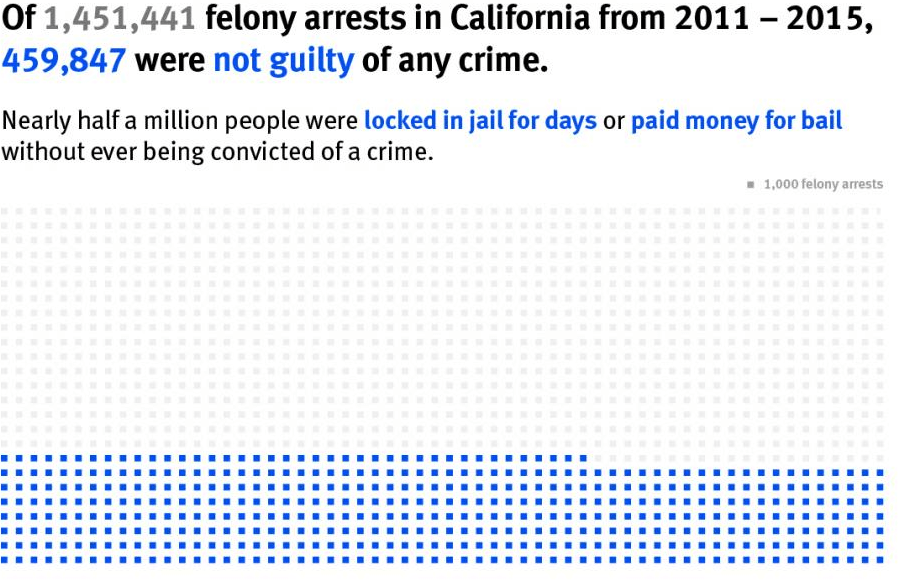
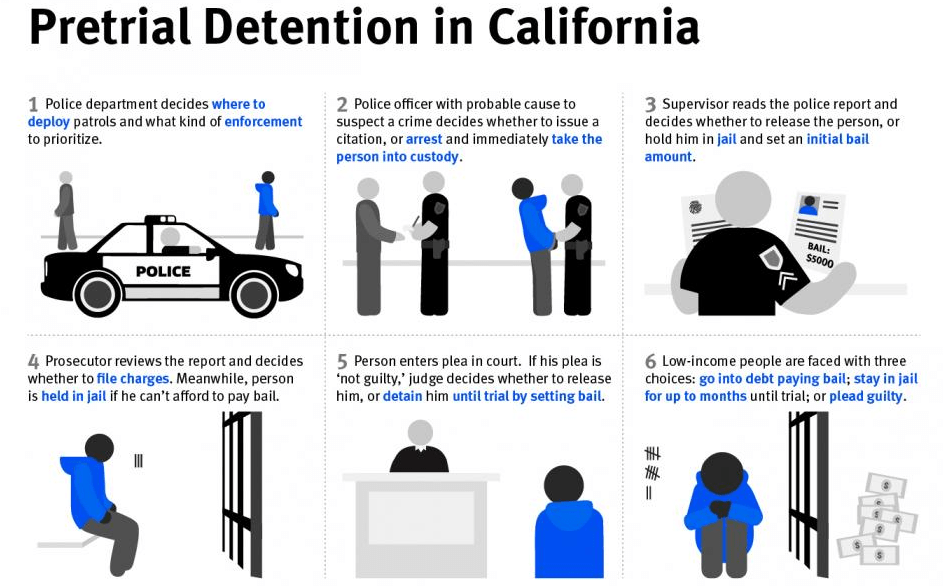
Every year nearly 1 million people are arrested in CA and booked into county jails. Their freedom to go home hinges on whether or not they can afford bail (the average bail in CA is $50,000). As a result of unrealistically high bails, 60% of people in jails nationally are legally innocent. They haven’t been found guilty of any crime, but they can’t afford bail so they sit in jail until their trial.

bail 2.PNG

Others may opt to work with for-profit bail companies to have those entities put up their bail. Bail bondsmen require a nonrefundable fee, usually about 10-15% of the bail, and they put up the rest. This type of commercial bond is a three-party contract between the defendant, the court, and the bond agent. The bond agent agrees to forfeit the bail amount if the defendant fails to appear in court. On the streets surrounding any local jails there will be a proliferation of bonds businesses advertising their services.

bail

The US is one of only two countries (the other is the Philippines) that allows private bail trade. As one would expect this a very lucrative and profitable business. The for-profit bond industry is estimated to be worth more than $2 billion with upwards of 15,000 bail agents across the country. The 8th amendment is noted for its ban on cruel and unusual punishment, but also tucked in the constitutional language is a ban on excessive bails. This constitutional right is routinely flouted by courts in assigning bails. Instead of the severity of crime in determining the bail amount, it often depends on the jurisdiction in which one commits a crime that determines the bail.

CA bail.PNG

The for-profit bond reform movement has been swiftly moving throughout the country. Two dozen states have already adopted legislation geared at tackling this issue. Currently, Legislation is making it’s way through CA that would reform the for-profit bail system.

The CA proposal would establish a county-by-county review board that would oversee defendant’s cases and their likely public safety risk when they’re arrested before giving courts recommendations about the terms of releases. The Bill would direct the review boards to base any release decision on whether someone is likely to re-offend or show up in court. This piece of legislation is a good start in the right direction of equalizing treatment for all. In our current system it’s better to be rich and guilty than poor and innocent.

One of the many mistakes the current Administration is making

Inmate education programs should not be a bipartisan issue. Let’s actually rehabilitate these people while they are incarcerated, we refer to prisons as “Corrections” institutions anyway, so let’s fuel the proliferation of educational programs that can empower & liberate inmates. Instead, the current administration has signaled that it plans to terminate such programs. Amy Lopez was hired by the Obama administration to overhaul educational programs in federal prisons in hopes of easing re-entry into society. The recent decision to fire Lopez and squash educational programs is tragic on so many levels. Attorney General Jeff Sessions believes education doesn’t have much benefit in reducing recidivism. Empirical studies and common sense indicate that Sessions is delusional in thinking educational programs are a waste of resources. Education is a relatively low-cost program & when you look at the direct savings (for every dollar invested in a prison education program it will ultimately save taxpayers $4-5 in re-incarceration costs) that’s an enormous savings.

Now for the good news. States can take the charge and choose not to follow suit in adhering to Session’s guidelines. Of the 2.3 million people incarcerated in the US, only 197,000 are in federal prisons. The current administration has rejected compassion and financial savings as a M.O. by gutting these educational programs. It’s time for States to step up. In CA,  CDCR, the largest prison system in the world, and the California Community College system, the largest higher education system in the world, have announced a partnership. Throughout US history, CA has cultivated it’s own unique exceptionalism. The time is now for other states to replicate CA’s model of face-to-face instruction model in prisons.

Prop 47 is the gift that keeps giving

Since the passage of Prop 47 in November ’14, there have been 40,00 fewer felony convictions in CA thanks to the realignment of felony classifications for property and drug crimes. CA has saved $103 million from not putting these groups of offenders behind bars. Per the language of Prop 47, CA is mandated to distribute the savings to counties to spend on programs that help formerly incarcerated individuals rebuild their lives. Alameda County is investing Prop 47 savings to help those with mental health and substance abuse issues. Indeed Prop 47 has proven to be a really, really good piece of legislation.

Good books to read Part II

Part I

Locking Up Our Own: Crime and Punishment in Black America — James Forman Jr.

  • Forman takes readers on a journey into the heart of Black America by using Washington DC as a case study to understand how a majority black jurisdiction ended up incarcerating so many of its own. This delicate question is answered with grace as Forman traces the development of a phenomena he labels ‘politics of responsibility’. Starting in the 70’s prominent Black leaders in DC lobbied for more punitive measures to fight drug dealing and gun violence without realizing their real-time responses to crime would result in the monolithic force of mass incarceration. Black leaders in DC didn’t ignore the epidemic of black-on-black violence, as critics of BlackLivesMatter often argue, but instead ferociously confronted the issue with the pre-existing legal tools at their disposal. Forman also highlights the role Eric Holder, then DC District Attorney, played in escalating and exasperating the incarceration crisis with his initiative to increase the use of pretext stops to root out drugs and violence in the community. Pretext stops gave cops wide latitude to stop cars and search them for guns, which effectively green-lighted racial profiling as an acceptable police tactic. Locking Up Our Own is a seminal work in the post-Obama era that will change how one views the forces that have shaped mass incarceration. As Forman writes, “Our system never treated the failure of prison as a reason not to try more prison.”

Dreams from the Monster Factory: A Tale of Prison, Redemption, and One Woman’s Fight to Restore Justice to All — Sunny Schwartz

  • The blueprint for the future of prisons is contained in this book. Schwartz’s unflinching me against the world attitude comes through with every page as she aims to take on the monster factories that produce & reproduce unrepentant convicts. Schwartz challenged the status quo in San Francisco jails of letting inmates sit around idly as a way to ‘do their time’. Instead she revolutionized the use of restorative justice to get criminals to accept accountability and develop empathy by learning to talk about their feelings. ‘Hurt people hurt people’ is the foundation of Schwartz’s work as she seeks to dive deep into the criminal mind to get them to reevaluate life decisions. Schwartz gathered the most violent offenders, put them in one dorm, and worked them through 12 hours of programs everyday. The results are staggering. Men who have committed horrible, unthinkable crimes come together and use the restorative justice model to confront their internal male role model system and dismantle their violent tendencies. Schwartz weaves in her personal issues to help the reader come to the omnipotent conclusion that perhaps we all have monsters inside of us. Humans don’t belong in cages, but monsters do. But not all monsters have to be that way for the rest of their lives.

Smart on Crime — Kamala Harris

  • Kamala Harris relies on her experience as a career prosecutor to outline thoughtful solutions to addressing the age old problem of criminality.  Harris understands the root causes of crime are inadequately addressed by solely relying on incarceration. While DA in San Francisco Harris created programs that targeted truancy rates as an early intervention approach to help kids get back on the right track. Harris joined the DA’s office to reform it from inside, a noble position given that most choose to critique from the outside instead of actually doing anything to change the system. Harris argues that crime isn’t a partisan issue, everyone wants to feel safe walking home or commuting on public transit to work. Feeling secure is a civil and human right to Harris and she is willing to fight to make sure everyone has this warm feeling at all times. This book is concise, direct, and reads more like a textbook than a novel. This blogger also agrees with Obama that Harris is a truly stunning woman, both intellectually and appearance wise. 

A Colony in a Nation — Chris Hayes

  • Hayes convincingly argues that the US has fractured into two separate entities: A colony for people of color, and a nation for the hegemonic white class. Hayes paints a picture of the parallel circumstances of the colonists in the late 18th century fighting British oppression and the current plight of poor people of color in society. This book builds on Frantz Fanon’s work The Wretched of the Earth  to understand the dynamics of internal colonialism. The central premise that it’s inherently incompatible and unsustainable to have a colony inside a nation produces some grim and uneasy feelings. It’s even more horrifying to realize that we created this internal colony using democratic means. The implications for the criminal justice system are profound and illustrates how easy it is to divide and conquer — just as the settlers did to the indigenous tribes of North America in the 16th and 17th centuries.

City of Inmates: Conquest, Rebellion, and the Rise of Human Caging in Los Angeles — Kelly Lytle Hernandez

  • History teaches us that mass incarceration is mass elimination and UCLA Professor Kelly Hernandez takes up this point using Los Angeles as an example of the dangerous potential for locking up whole classes of people. Los Angeles incarcerates more people than any other city in a country that incarcerates more people than any other place on earth. Hernandez uncovers two centuries of history about native elimination, immigrant exclusion and black disappearance that drove the force of mass incarceration in Los Angeles. This work spans from Spanish colonialism to the Watts riots of 1965 to illuminate how deeply woven incarceration is into the fabric of the city of Angels. City of Inmates also demonstrates how the oppressed resisted the oppressors, culminating in the 1965 riot that set the city on fire. Some may think that mass incarceration as we know it sprouted up in the 1970’s during the War on Drugs, but this book provides a deeper, more accurate portrayal of the history of mass incarceration. A must read for anyone who grew up in Los Angeles.

The Contradictions of American Capital Punishment — Franklin Zimring

  • Franklin Zimring, quite likely the most foremost criminologist in the world and this blogger’s favorite professor at UC Berkeley, writes persuasively about the continued reliance on capital punishment despite global trends away from the practice. Zimring theorizes that the debate over capital punishment is indicative of a long standing division over American values, but believes ultimately that abolishment is on the horizon. The death penalty seems to violate our most esteemed legal principles of Due Process and fairness. Our continued use sets us apart from global allies as most European nations see capital punishment as barbaric and an appalling aspect of American exceptionalism. But the death penalty also seems to hold some sort of nostalgic value in violent social justice that views the executioner as the agent of local control and community safety. Zimring unearths that the most troubling symptom of the attraction to vigilante justice is the lynch mob by showing that the majority of executions in recent decades have occurred in precisely the Southern States where lynchings were most common a hundred years ago. This legacy underscores the appeal of the death penalty and provides one of the most convincing reasons for abolishing it. Readers will come away with a better appreciation of the history of capital punishment and how closely entwined the institution is with lynch mobs.